Why Mushroom Identification Apps and Photos Are Not Enough
Mushroom apps and photo matches can suggest possibilities, but they cannot confirm a wild mushroom is safe. Learn the limits, the risks, and safer next steps.
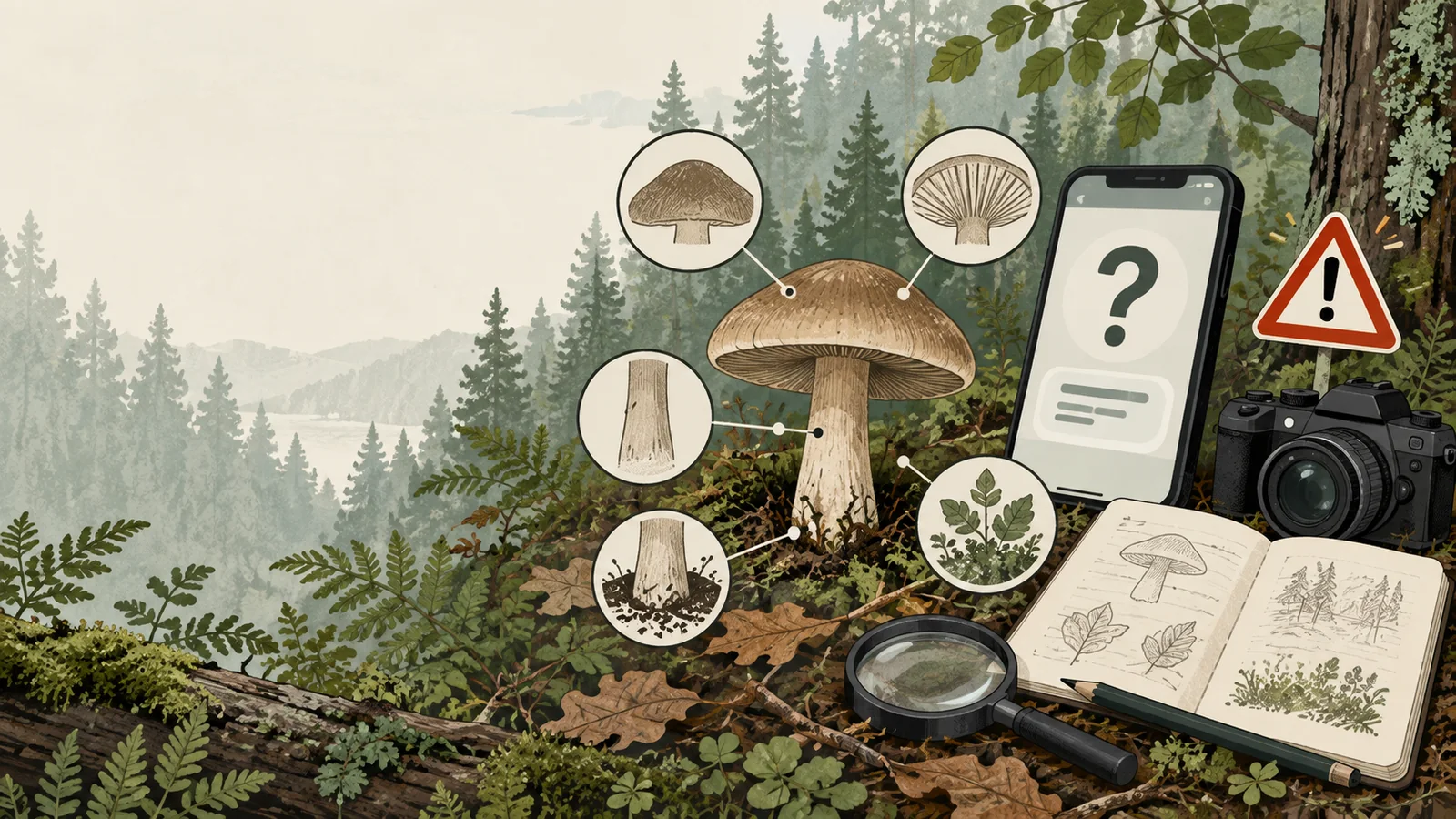
Mushroom-identification apps, image searches, social-media groups, and AI tools can be useful starting points for curiosity. They can help a person notice a fungus, learn basic vocabulary, record a date and habitat, or generate a list of possibilities to investigate. They cannot reliably answer the question that matters most in a foraging situation: is this particular mushroom safe to eat or use?
A digital match is not a safety determination. It is a hypothesis, often based on incomplete visual information. A potentially harmful mushroom can be photographed from an angle that hides its most important features, appear very different at another age or moisture level, or resemble a safer-looking species closely enough to fool a casual observer. For wild mushrooms, uncertainty should lead to a simple decision: do not ingest it. If someone may already have eaten an unknown mushroom, contact Poison Control in the United States at 1-800-222-1222 immediately rather than waiting for an online identification result, since look-alikes can be dangerous and symptoms may not begin right away.
The short answer
An app or photo can help generate possibilities. It cannot replace a complete identification based on the whole specimen, its habitat, its substrate, its age, its physical structures, regional context, and, when appropriate, review by a qualified local expert. Even when an app seems confident, its result may be wrong because it is comparing a photo to incomplete or uneven training data. It cannot reliably inspect features outside the frame, feel texture, examine the buried stem base, make a spore print, use microscopy, confirm a specimen's substrate, or determine whether a look-alike is present in a given region.
The risk is not theoretical. Some Amanita mushrooms contain amatoxins that can cause liver failure and death. The CDC has reported that the genus Amanita includes roughly 600 species and that some produce amatoxins; early gastrointestinal symptoms can be followed by a period when symptoms seem to improve even while serious liver injury progresses.
What mushroom apps can do well
Used responsibly, apps and image-recognition tools can be useful for observation and learning. They may help a user record a date, broad location, weather, habitat, and preliminary taxon suggestion; learn the difference between gills, pores, teeth, veils, rings, volvas, stems, caps, and substrates; compare a specimen with multiple possible groups rather than relying on a single common name; organize photographs for later review by a local mycological society, extension service, herbarium, fungarium, or other qualified identifier; and notice uncertainty in ways that prompt better questions, such as what a mushroom is growing on or whether its base was photographed. That is a valuable role. The problem begins when a suggestion is treated as a verdict.
What an app or photo cannot see
A photo only records what the camera captured, and it may leave out the very details needed to distinguish one mushroom from another: the entire mushroom including the base below soil, mulch, or leaf litter; whether a bulb, cup-like volva, veil remnants, ring, cortina, or rooting stem is present; the underside clearly enough to evaluate gills, pores, teeth, folds, attachment, spacing, and color; reliable color, since lighting, cameras, screens, filters, and automatic color correction can shift tones substantially; texture, odor, latex, bruising behavior, or flesh color after cutting; the growth pattern -- solitary, scattered, clustered, tufted, or forming a ring; the substrate, whether soil, dead wood, buried wood, mulch, dung, moss, leaf litter, a living tree, or another fungus; nearby tree species; and a useful spore print, microscopy result, DNA result, or voucher specimen review.
Montana State University Extension's Schutter Diagnostic Lab advises people submitting mushrooms for identification to include the cap, stem, and especially the underground structures, and recommends sending at least two fresh specimens, ideally including both young and mature examples. That guidance captures the central limitation of app-only identification: if an expert needs the whole specimen and multiple life stages to evaluate a mushroom, a single phone photo cannot safely settle an ingestion decision.
Why the same mushroom can look different
Mushrooms are not static objects. A species can change quickly as it develops, dries, becomes waterlogged, is damaged by insects, is exposed to sun, or ages. A young mushroom may look rounded or egg-like; a mature one may flatten, split, fade, curl, become slimy, lose veil remnants, or change color. Rain can darken some caps while dry weather makes them appear pale, a stem may be partly buried or broken, and gills may be hidden by the camera angle. The same species can also vary from one region, elevation, host association, or habitat to another. This variability is one reason experts do not identify mushrooms by color alone, and why an app's high-confidence percentage should not be mistaken for high confidence in the real world.
Why look-alikes make the stakes higher
"Looks like" is one of the most dangerous phrases in wild mushroom identification. Many mushrooms share broad visual traits -- brown caps, pale gills, a ring on the stem, clustered growth, lawn habitat, wood-growing habit, or a seasonal appearance after rain -- and a common name can make confusion worse, since common names vary by region and may be applied to unrelated species. Some toxic mushrooms can resemble edible species; others may be mistaken for fungi that are merely nonfatal, creating false reassurance. America's Poison Centers warns that poisonous mushrooms often resemble mushrooms people consider safe, and that cooking does not reliably remove or inactivate mushroom toxins. The safest approach is not to memorize one shortcut -- it is to learn that accurate identification rests on multiple independent features, then obtain qualified verification before eating an unfamiliar wild mushroom.
The details experts examine
A reliable identification may require a combination of field observations, careful photographs, a physical specimen, and specialized examination. Poison Control lists features mushroom experts may examine, including cap shape, color, and texture; gills or pores; spore color; the stalk and its base; bruising or cutting reactions; cap attachment; growth pattern; and what the mushroom is growing on. For field documentation, it helps to record as much of the following as possible, without treating the process as permission to eat the specimen: a full view of the mushroom in place before removal; the top of the cap and the underside; the full stem, intact base, and any underground structure; the substrate and nearby plants or trees; several specimens at different ages, if present; the date, broad region, elevation if known, and recent weather; and notes about color, odor, texture, growth pattern, and whether the specimen is changing as it ages.
The U.S. Forest Service's fungal collection guidance likewise emphasizes collecting the entire specimen, documenting substrate and habitat, noting fresh characteristics, and obtaining multiple specimens at different life stages for a high-quality collection record.
How to use an app more safely
If you use a mushroom app, treat it as a notebook and a question generator, not as a consumption decision-maker. Photograph before touching or removing the specimen, capturing it in habitat from multiple angles when it is safe and legal to do so. Record uncertainty using labels such as "unknown mushroom," "possible genus," or "needs expert review," rather than selecting the most appealing result. Check whether the whole specimen was captured -- if the stem base, underside, substrate, or habitat is missing, the record is incomplete. Seek local expertise: a regional mycological society, extension resource, university collection, or qualified identifier may know local species and look-alikes that an app cannot account for. Do not eat based on a match, since agreement among multiple apps, users, or image-search results is not a substitute for qualified confirmation. And respect land and conservation rules -- a documented species occurrence does not mean it is currently present, safe, legal to collect, or located on land open to public access.
For anyone building a private field notebook, an app can be genuinely useful for logging the general region, date, habitat, substrate, images, and identification status. Keep exact locations private by default, especially for sensitive habitats, private land, rare species, or culturally significant organisms.
If someone already ate an unknown mushroom
Do not wait for an app, an online group, or a photo-identification reply. In the United States, call Poison Control at 1-800-222-1222 immediately if a person, child, or pet may have eaten a wild mushroom -- wild mushrooms may be dangerous even when they resemble familiar-looking species. If it is safe to do so, keep a sample or take clear photographs of what remains, and note the approximate time of ingestion, amount eaten, age and weight of the exposed person, symptoms, and any medications. Do not induce vomiting unless instructed by Poison Control or a medical professional.
The bottom line
Mushroom apps are useful learning tools. They are not edible-certification tools, toxicology tools, or emergency-response tools. Use an app to improve observation skills, keep field notes, and learn the questions experts ask. Use real, traceable photographs and qualified local expertise for education -- but do not turn an app result into a decision to ingest a wild mushroom. Curiosity belongs in the field; certainty belongs before ingestion.
Frequently asked questions
Can an app identify a mushroom from a photo?
An app can suggest possible matches from the images and information it receives. It cannot reliably establish that a particular wild mushroom is correctly identified or safe to eat. Important traits may be hidden, poorly photographed, altered by weather or age, or impossible to determine from an image.
Can I eat a mushroom if two apps agree?
No. Multiple apps may rely on similar image-recognition methods, incomplete visual information, or the same incorrect assumptions. Agreement among apps is not expert confirmation and is not a safety determination.
Can I identify a mushroom from cap color alone?
No. Cap color can vary with species, age, moisture, weather, lighting, camera processing, and damage. Accurate identification usually depends on multiple traits, including the underside, stem, base, habitat, substrate, and other evidence.
Does blue bruising prove a mushroom is safe or psychoactive?
No. Color changes are not a safety test. A bruising response is only one possible observation and cannot establish species identity, legal status, edibility, or safe use.
Does cooking make poisonous mushrooms safe?
No. Cooking does not reliably remove or inactivate toxins in poisonous mushrooms. America's Poison Centers explicitly warns that cooking does not make poisonous mushrooms safe.
What should I do if I ate an unknown mushroom?
Call Poison Control in the United States at 1-800-222-1222 immediately, even if symptoms have not started. Call 911 or seek emergency care for severe symptoms such as trouble breathing, seizures, collapse, unconsciousness, chest pain, severe confusion, or rapidly worsening illness.
What photos should I take when asking for educational identification help?
Take clear photos of the whole mushroom in habitat, the cap, underside, full stem, intact stem base, substrate, nearby trees or plants, and multiple specimens at different ages when possible. Record the date and broad region. These photos can support an expert discussion, but they do not make a mushroom safe to ingest.
Can I forage mushrooms on public land?
Rules vary by land manager, site, closures, species, quantity, purpose, and whether collection is personal or commercial. A public occurrence record does not establish permission to enter land or collect organisms. Check with the specific managing agency and obtain private-land permission before collecting.
Sources
- Mushroom poisoning: Don't invite "the death angel" to dinner
- Amanita Species Mushroom Poisonings, MMWR
- MSU Extension Schutter Diagnostic Lab: Sample Submission Forms — Mushroom Identification
- America's Poison Centers: Food and Mushroom Tips
- USDA Forest Service: Handbook to Additional Fungal Species of Special Concern in the Northwest Forest Plan
- Poison Control: Poisonous and non-poisonous plants — An illustrated list