01
Why people use it
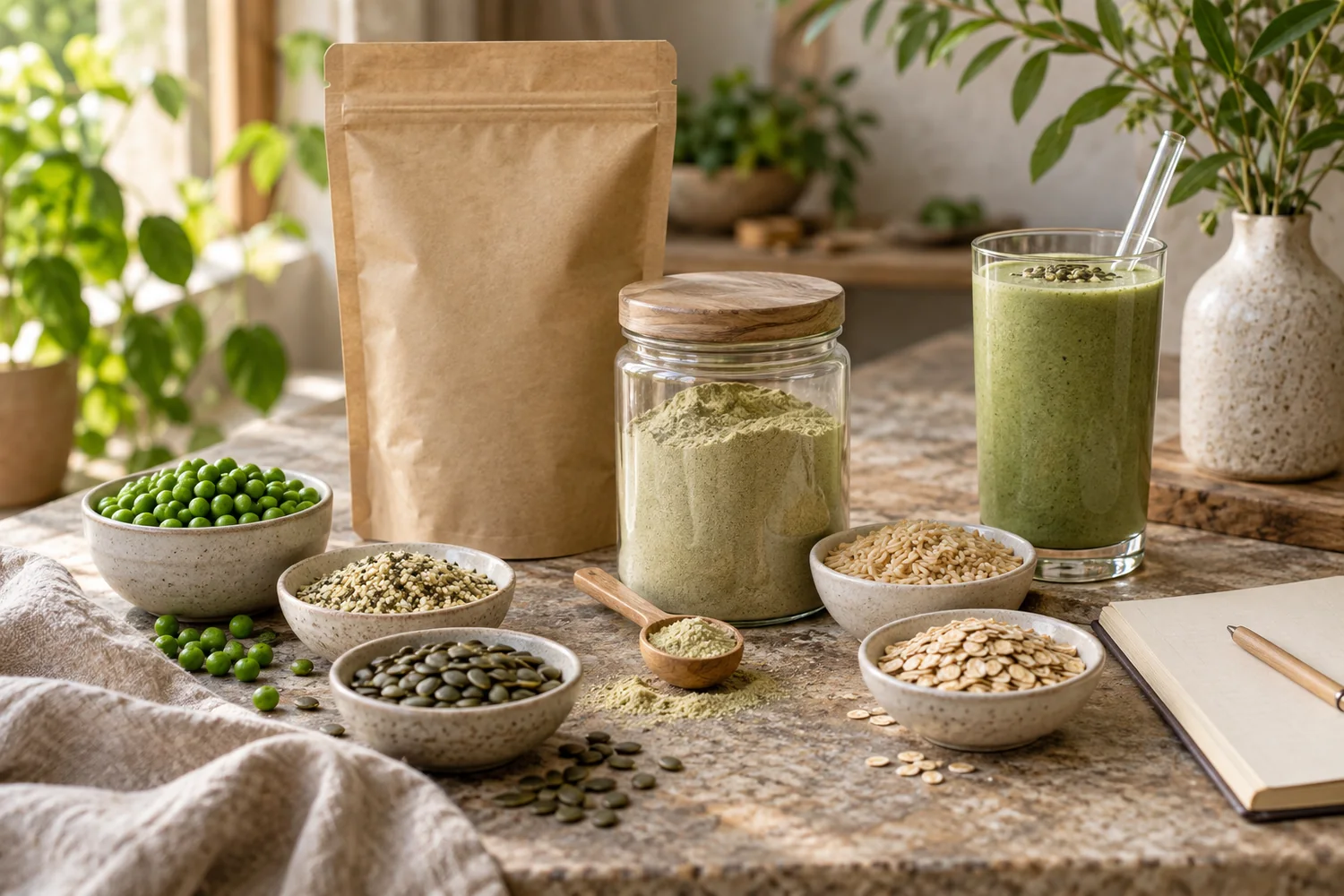
Individual plant proteins are typically incomplete on their own, but blends that pair complementary sources -- most commonly pea and rice -- cover all nine essential amino acids, and head-to-head clinical trial data has found pea protein performs comparably to whey for muscle gains.
- ✓Meeting daily protein targets on a plant-based diet
- ✓Post-exercise muscle recovery support
02
What the evidence says
This is a nutrient category with real head-to-head clinical trial evidence directly countering a common assumption: a well-designed randomized controlled trial found pea protein produced muscle gains statistically indistinguishable from whey protein, not just a plausible-sounding amino-acid argument.
Hover, focus or tap each label for context.
These labels summarize the available context; they are not a clinical recommendation.03
Common forms
Hover, focus or tap a form to see what it means.
Safety note
Know before you use it
A "vegan" label on a protein powder says nothing about its quality, contaminant testing, or actual amino acid completeness -- a clean, third-party-tested blend and a gritty, poorly sourced one can carry the identical label. Checking whether a product uses a complementary blend (such as pea and rice) or a single naturally complete source (such as soy) is more useful than assuming any plant protein powder automatically delivers a full amino acid profile. Anyone with kidney disease should discuss protein supplementation, of any type, with a clinician before increasing intake significantly, since high protein intake can be relevant to kidney function in that specific population.
Sources & review
- Is Vegan Protein Powder Good for You? A Complete Evidence-Based GuideNaked Nutrition
- Best Vegan Protein Powder: Complete Plant Proteins That Actually Taste GoodUseful Vitamins (citing Babault et al. RCT and a 2024 British Journal of Nutrition study)
- The Best Plant-Based Protein Powders, With Advice From DietitiansForbes