01
Why people use it
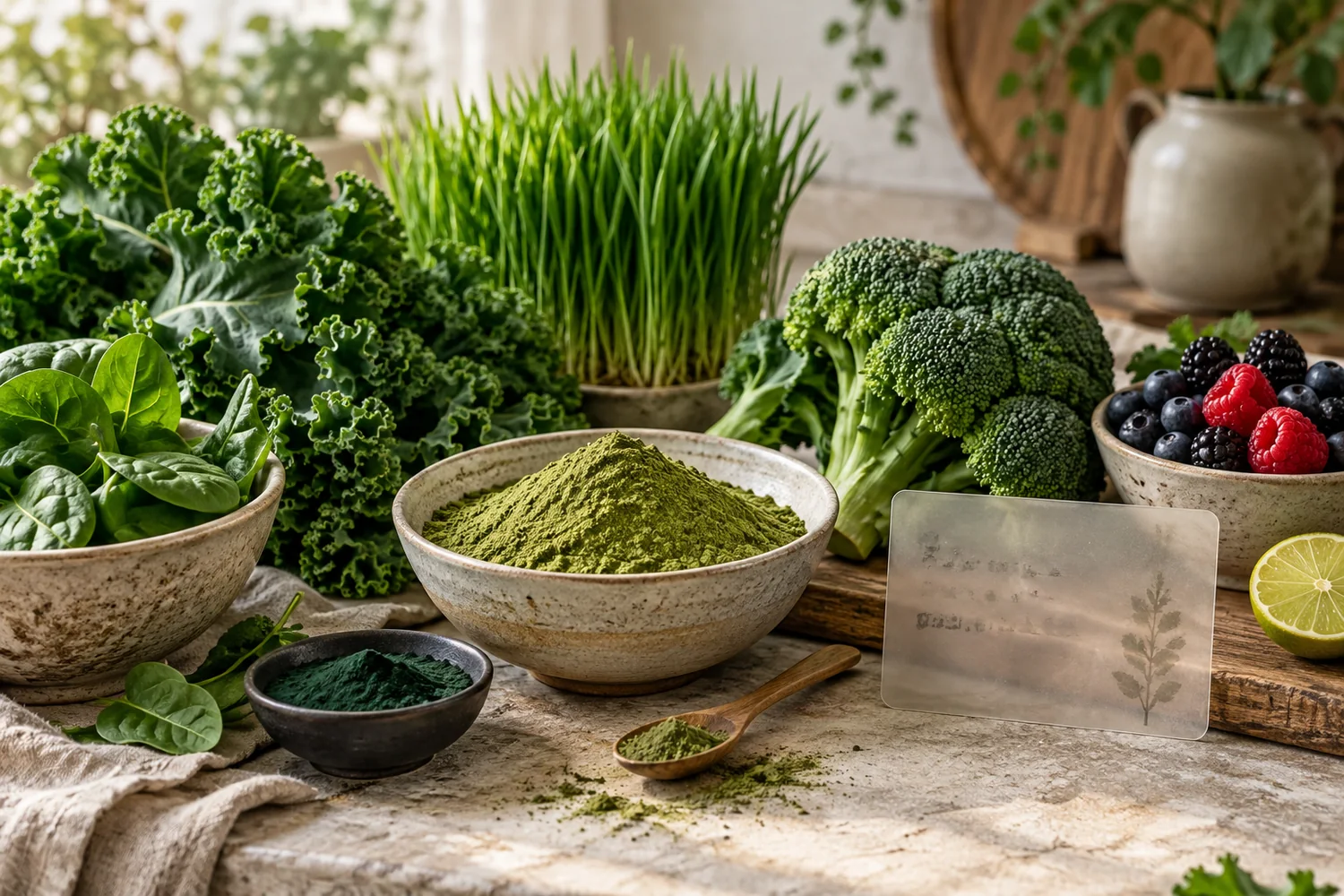
Greens powders are a convenience product, not a vegetable replacement -- dehydration and processing reduce nutrient and fiber content compared to whole vegetables, and proprietary blend labeling makes it genuinely hard to know how much of any individual ingredient a serving actually contains.
- ✓A convenience supplement, not a whole-vegetable substitute
- ✓A vehicle for added synthetic vitamins and minerals in some formulas
02
What the evidence says
Most of the clinical evidence that exists applies to individual ingredients studied on their own -- spirulina, chlorella, wheatgrass -- rather than to the multi-ingredient blends actually sold as greens powders, and the proprietary-blend labeling common across the category discloses total blend weight but not individual ingredient amounts, which makes it genuinely difficult to connect any single-ingredient research finding to what's actually in a given scoop.
Hover, focus or tap each label for context.
These labels summarize the available context; they are not a clinical recommendation.03
Common forms
Hover, focus or tap a form to see what it means.
Safety note
Know before you use it
Dehydration and processing cause real losses of heat-sensitive nutrients like vitamin C, and the fiber content of a whole vegetable is largely removed in powder form -- a greens powder is not nutritionally equivalent to the vegetables pictured on its label. Vitamin K deserves specific attention: leafy-green-heavy blends can contain enough to create a meaningful interaction risk for anyone taking warfarin or another blood-thinning medication, since vitamin K directly affects how those medications work. Anyone on blood thinners, or managing a chronic kidney or health condition, should check the specific ingredient list and vitamin K content with a clinician or pharmacist before adding a greens powder to their routine.
Sources & review
- Greens Powder: Benefits & ScienceSuperpower
- Greens Powder: What the Evidence ShowsCurate Health
- Greens Powders: Benefits, Types, Dosing, and Side EffectsDr. Brad Stanfield