01
Why people use it
A practical, evidence-aware guide to common juniper (Juniperus communis): traditional uses, modern research, safe identification, harvesting, culinary preparation, storage, and contraindications.
- ✓Culinary spice (crushed dried cones)
- ✓Traditional digestive support (mild dyspepsia, gas)
- ✓Traditional urinary-flow use
02
What the evidence says
Common juniper contains volatile aromatic compounds (alpha-pinene, beta-pinene, sabinene, limonene, myrcene, terpinen-4-ol) plus polyphenols, with antioxidant, antimicrobial, anti-inflammatory and metabolic signals reported in cell and animal studies. These are preliminary: a laboratory finding does not show that a tea, tincture, capsule or essential oil treats disease in people. One 2025 randomized, double-blind, placebo-controlled trial found a specific standardized 100 mg juniper-oil product improved functional-dyspepsia symptoms over 28 days in 76 adults -- useful evidence for that product and condition, not proof that self-foraged berries or homemade preparations do the same. A 2023 study of a methanolic berry extract reported metabolic-signaling and blood-glucose effects in high-fat-diet mice; this does not establish a safe or effective human treatment for diabetes, obesity or metabolic syndrome. Juniper should not replace diagnosis or treatment for urinary pain, fever, blood in urine, flank pain, suspected kidney stones, recurrent infection or persistent digestive symptoms, and it is not a treatment for urinary tract infections, kidney infections, chronic kidney disease, diabetes, cancer, autoimmune disease, arthritis or respiratory infection.
Hover, focus or tap each label for context.
These labels summarize the available context; they are not a clinical recommendation.03
Common forms
Hover, focus or tap a form to see what it means.
+
Traditional and practitioner context
Across European, Middle Eastern, Asian and Indigenous North American traditions, juniper has been used as food, medicine, fragrance, smoke and household material, though traditional practices differ by culture, region, species and preparation and should not be treated as one uniform system. In European herbalism, common juniper fruit was commonly used as an aromatic digestive herb for poor appetite, bloating, gas and dyspepsia, and to increase urine flow in minor urinary complaints -- historical preparations included crushed-fruit teas, tinctures, medicinal wines, conserves, syrups, baths, liniments and fumigation. During plague eras juniper was burned to scent and "purify" air under miasma theory; that practice is historically important but did not cure plague and is not an evidence-based infection treatment. Documented Indigenous North American uses are culturally specific, with ethnobotanical records including berry, branch, root and twig preparations for colds, chest discomfort, stomach complaints, aches and urinary concerns -- respectful use of this history means naming the specific tradition when known, not treating it as proof of modern clinical efficacy.
+
Foraging index
Common juniper identification and lookalikes
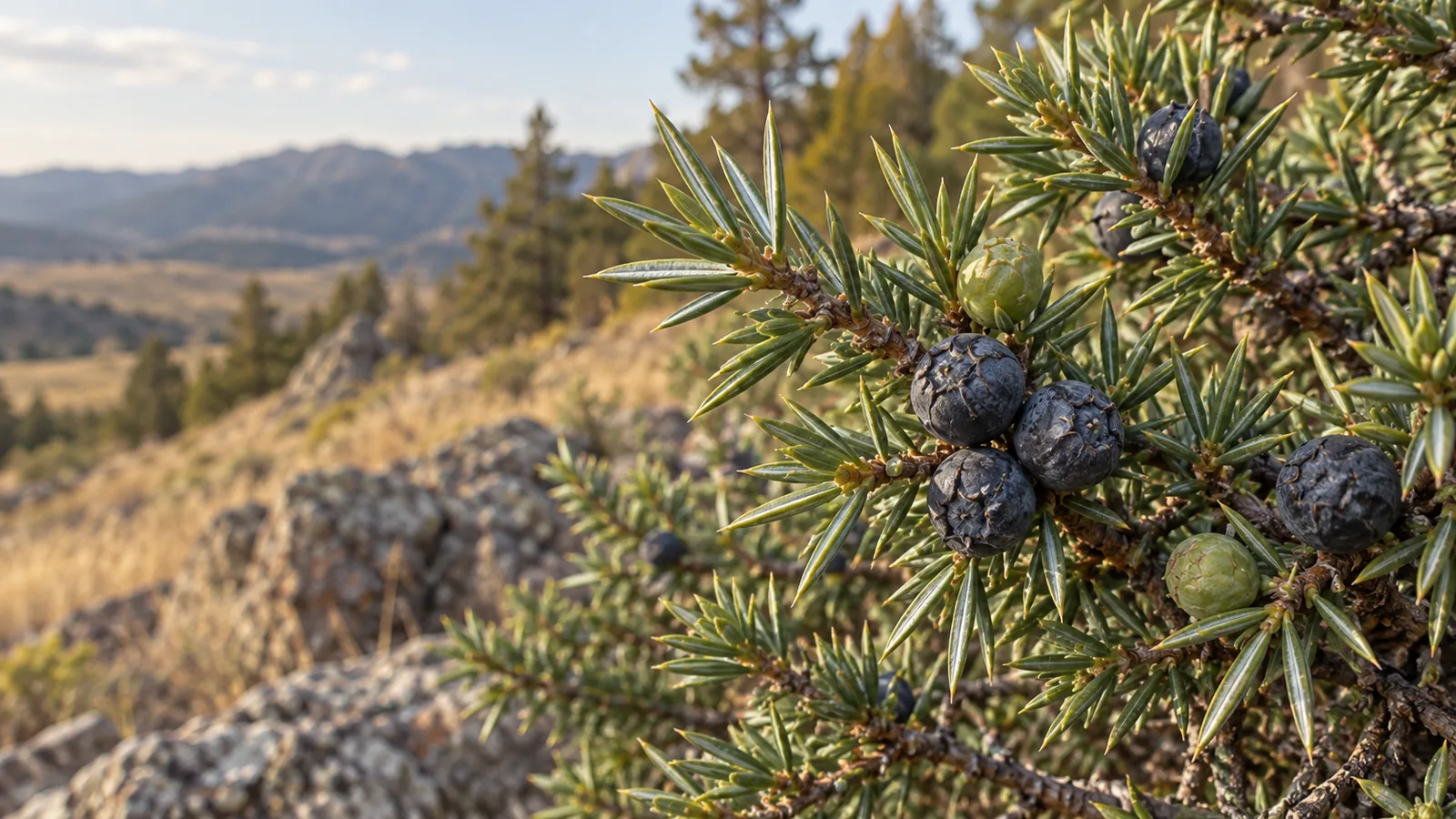
A confirmed Juniperus communis plant shows individual, stiff, sharply pointed needles (not just flattened scale leaves) in whorls of three, a broad pale stomatal band along the upper face of each needle, a distinctly prickly feel, and mature seed cones 6-13 mm wide that are blue-black to purple-black with a pale waxy bloom. If a plant does not meet the full checklist, do not harvest it. Never identify a plant by blue fruit alone: savin juniper (Juniperus sabina) is chemically distinct with a toxic reproductive profile and is not a culinary substitute, and yew (Taxus species) is not a juniper at all -- it has flat, soft needles and red cup-like arils rather than blue-black cones, and its foliage and seeds are highly toxic. Avoid unknown juniper species, ornamental cultivars, and plants from landscaped, roadside or industrial sites that may carry pesticide or contaminant residue. Common juniper cones typically take about two years to ripen, so a single shrub can hold green immature cones and dark ripe cones at once; in Montana and similar northern climates, ripe cones are commonly found from late summer into autumn (roughly August through October), though elevation and weather shift the timing. Harvest lightly and selectively -- confirm identification and legal permission first, pick only ripe, intact, dark cones by rolling or twisting them gently off a healthy shrub, and take a small amount from several plants rather than stripping any one of them.
Status: Requires careful identification. Broad occurrence never confirms identity, safe use, legal access or permission to harvest.
Read the responsible foraging guide →Safety note
Know before you use it
Do not use medicinal juniper (tea, tincture, capsules, extract, or essential oil) if pregnant, trying to conceive, or breastfeeding; living with kidney disease, kidney inflammation, or impaired kidney function; experiencing painful urination, fever, urinary spasms, flank pain, blood in urine, reduced urine output, or unexplained swelling; taking prescription diuretics without a clinician's or pharmacist's clearance; following a medically prescribed fluid restriction; or allergic to juniper or cypress-family plants. The European Medicines Agency notes renal damage has been reported after long-term use and essential-oil overdose, with seizures and kidney damage reported after intake above 10 g per day or prolonged high-dose use -- these are not a dose target, but a reason to avoid high-dose, long-duration self-treatment. Never swallow juniper essential oil; avoid undiluted skin application and keep it away from eyes, mucous membranes, broken skin, children and pets. Do not self-treat urinary symptoms with juniper if there is fever, chills, back or flank pain, blood in urine, nausea, vomiting, severe pain, or recurrent symptoms -- seek medical assessment instead. Savin juniper (Juniperus sabina) is chemically distinct and historically associated with a toxic reproductive profile; never forage or use it for food or medicine. Yew (Taxus species) is not a juniper and is highly toxic -- verify the whole plant, not blue fruit color alone, before harvesting anything.
Questions about Juniper Berries
Are juniper berries safe during pregnancy? →
What is the difference between common juniper and savin juniper? →
Sources & review
- EU herbal monograph on Juniperus communis L., pseudo-fructus (galbulus)European Medicines Agency
- Assessment report on Juniperus communis L., pseudo-fructus (galbulus)European Medicines Agency
- Efficacy and safety of Roleca juniper 100 mg in functional dyspepsia: a randomized, double-blind, placebo-controlled trialPhytomedicine, 2025 / PubMed
- Maternal reproductive toxicity of some essential oils and their constituentsInternational Journal of Molecular Sciences, 2021 / PMC
- Common Juniper, Juniperus communisMontana Field Guide