01
Why people use it
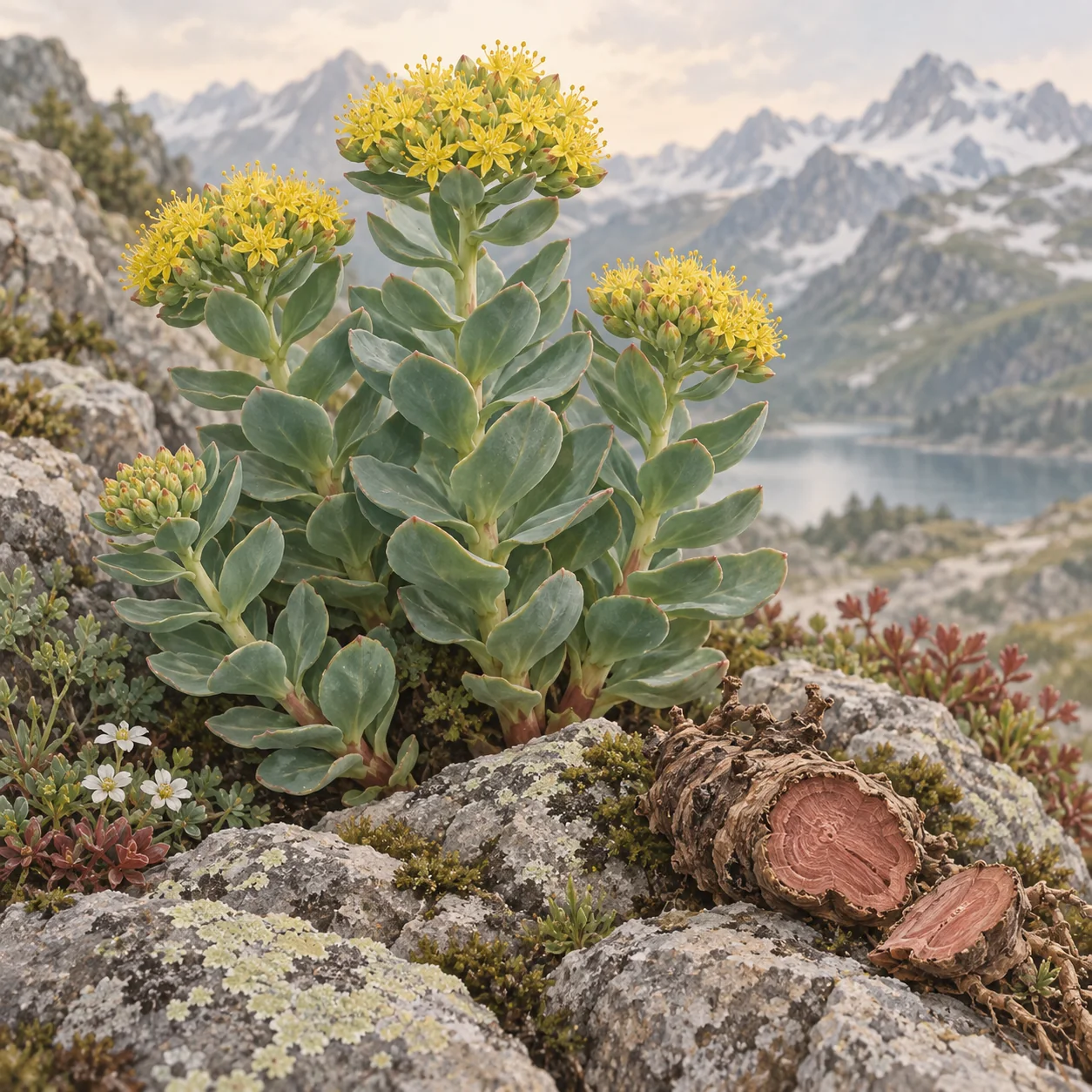
Rhodiola is an arctic and alpine root with Russian and Scandinavian traditions for fatigue and stress. Small trials of specific ethanolic extracts show mixed results, and the whole genus is now listed under CITES because wild root harvest threatens populations.
- ✓Traditional support during temporary stress and fatigue
- ✓Studied for stress-related burnout and mental performance
- ✓Russian and Scandinavian herbal traditions
- ✓Cold-climate cultivation and conservation interest
02
What the evidence says
About a dozen small placebo-controlled trials of standardized extracts have explored stress-related fatigue, burnout, mental performance and mood, with some positive signals but contradictory findings, high or unclear risk of bias and no independent replication. An NIH-funded trial in depression found no significant difference from placebo. NCCIH concludes there is not enough reliable evidence to determine whether rhodiola is useful for any health purpose, and the EU recognizes only traditional use, limited to two weeks in adults.
Hover, focus or tap each label for context.
These labels summarize the available context; they are not a clinical recommendation.03
Common forms
Hover, focus or tap a form to see what it means.
Trial results belong to specific standardized ethanolic extracts. Teas, powders, tinctures and isolated compounds are separate exposures, and adulteration with other Rhodiola species is common in trade.
+
Traditional and practitioner context
Rhodiola rosea, called roseroot or golden root, has documented use in Russian and Scandinavian herbal traditions for endurance and resilience in harsh climates. The USSR Ministry of Health authorized a liquid extract in 1969, a Soviet pharmacopoeial article followed in 1975, and products have been marketed in Sweden since 1987; the European Medicines Agency now lists a traditional use for temporary relief of stress symptoms such as fatigue and sensation of weakness. Traditional Chinese uses of “hong jing tian” generally involve other Rhodiola species and should not be attributed to R. rosea without a species-specific source.
+
Foraging index
CITES-listed; root harvest destroys the plant
Rhodiola rosea is native to arctic and subarctic North America, including Alaska, northern Canada, Greenland and northeastern coastal regions, with a rare disjunct population in the southern Appalachians. Because the traded article is the root, harvest destroys the slow-growing plant, and the entire genus was placed in CITES Appendix II in 2022. This library does not publish collection guidance; verified cultivated material is the only responsible source. Western North American “roseroot” is usually Rhodiola integrifolia, a different species.
Status: no harvest promotion; ethical cultivated supplier only. Broad occurrence never confirms identity, safe use, legal access or permission to harvest.
Read the responsible foraging guide →Safety note
Know before you use it
Rhodiola is more often activating than sedating: insomnia, agitation, irritability, dizziness, headache, dry mouth and stomach upset are reported. Avoid taking it late in the day or stacking it with stimulants. A small human study found a modest reduction in CYP2C9 enzyme activity, so ask a pharmacist before combining concentrated products with warfarin, phenytoin, losartan or other medicines with narrow dosing margins; this is a precaution, not a documented harm. Safety in pregnancy and breastfeeding has not been established and use is not recommended. The EU monograph limits traditional use to adults and to two weeks before seeking advice; safety beyond about twelve weeks is not characterized. If you take prescription medicines, are pregnant or breastfeeding, or are preparing for surgery or a procedure, review supplement or concentrated-product use with a qualified clinician or pharmacist before starting it.
Read the complete Rhodiola guide
Valerian, passionflower, rhodiola, bacopa and tulsi are often sold together as calm-and-focus supplements. Their traditions, evidence and safety profiles are not the same.
Open the full guideSources & review
- Rhodiola: Usefulness and SafetyNational Center for Complementary and Integrative Health
- European Union herbal monograph on Rhodiola rosea L., rhizoma et radix (Revision 1)European Medicines Agency, Committee on Herbal Medicinal Products
- Assessment report on Rhodiola rosea L., rhizoma et radix (Revision 1)European Medicines Agency
- The effectiveness and efficacy of Rhodiola rosea L.: a systematic review of randomized clinical trials (Hung et al., 2011)Phytomedicine / PubMed
- Rhodiola rosea for physical and mental fatigue: a systematic review (Ishaque et al., 2012)BMC Complementary and Alternative Medicine / PubMed
- Rhodiola rosea versus sertraline for major depressive disorder: a randomized placebo-controlled trial (Mao et al., 2015)Phytomedicine / PubMed
- Effect of commercial Rhodiola rosea on CYP enzyme activity in humans (Thu et al., 2016)European Journal of Clinical Pharmacology / PubMed
- CoP19 Proposal 45: inclusion of Rhodiola spp. in Appendix IICITES Secretariat
- USDA PLANTS profile: Rhodiola rosea (RHRO3)USDA Natural Resources Conservation Service