01
Why people use it
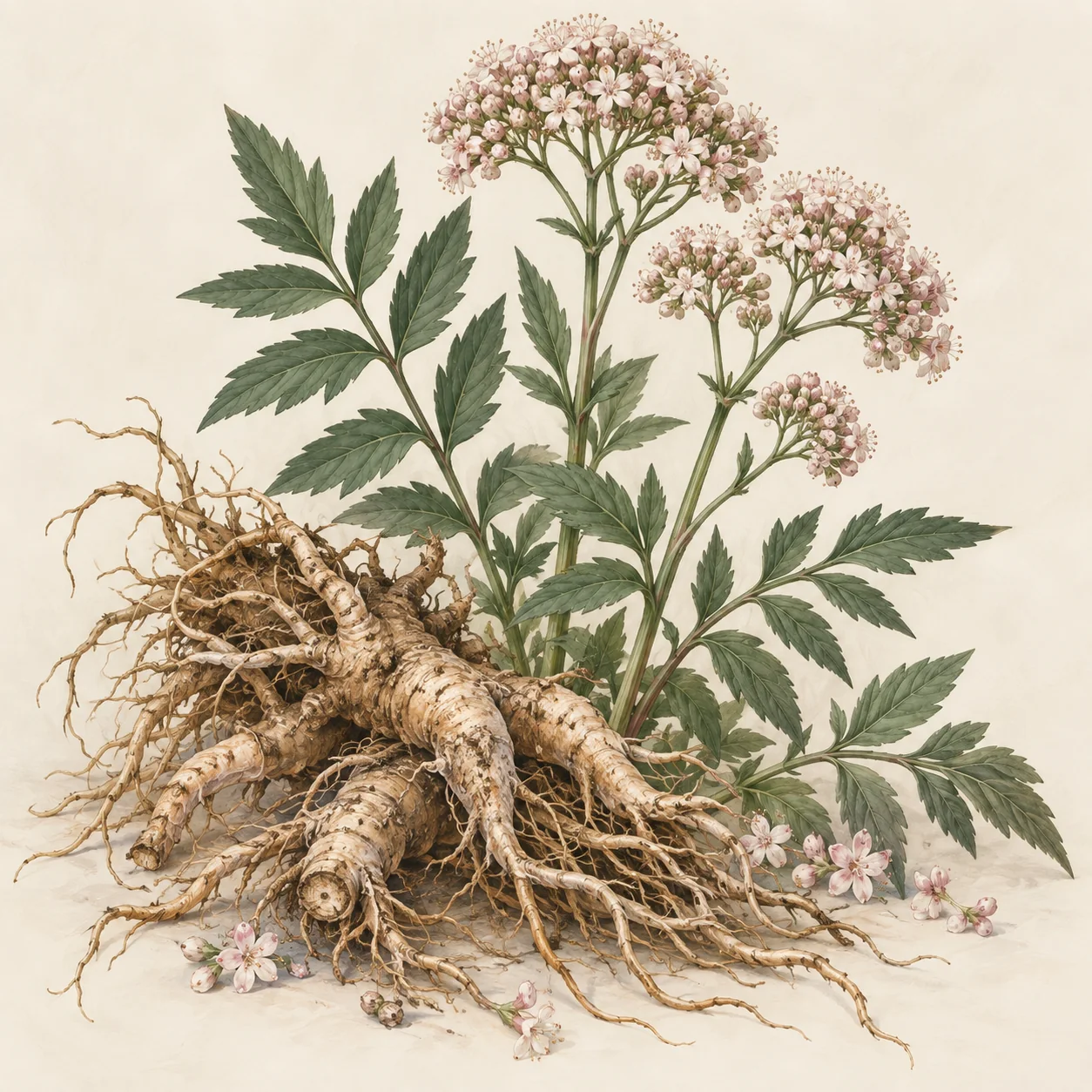
Valerian root is a European herb with a long tradition as a bedtime and nervous-tension remedy. Human trials suggest a modest, subjective improvement in sleep quality with specific extracts, but results are inconsistent and the evidence does not support it as a treatment for chronic insomnia.
- ✓Traditional aid to sleep and mild nervous tension
- ✓Evening tea and tincture rituals in European herbalism
- ✓Standardized-extract sleep-quality research
- ✓Bath additive and aromatic household use
02
What the evidence says
Meta-analyses of placebo-controlled trials find a modest, subjective improvement in sleep quality but no reliable effect on objective measures such as time to fall asleep, with wide variation in preparation, dose and study quality. The American Academy of Sleep Medicine suggests clinicians not use valerian for chronic insomnia, and the NIH Office of Dietary Supplements calls the evidence inconclusive. Evidence for anxiety rests on a single small trial.
Hover, focus or tap each label for context.
These labels summarize the available context; they are not a clinical recommendation.03
Common forms
Hover, focus or tap a form to see what it means.
Tea, tincture, powdered root and standardized ethanolic extract are different exposures. The trial evidence belongs mainly to specific extracts, and valerian–hops products are a separate lane.
+
Traditional and practitioner context
Valerian is traditionally used in European herbal practice for mild nervous tension and to aid sleep, prepared as a root tea, tincture, expressed juice, extract or bath additive; the European Medicines Agency recognizes this use in its herbal monograph. Ancient Greek and Roman physicians, including Hippocrates and Galen, described valerian for sleeplessness. The characteristic “old sock” odor develops in the dried root and is not a field-identification trait of the fresh plant.
+
Foraging index
Introduced garden escape in North America
Valeriana officinalis is native to Europe and western Asia and is an introduced, sometimes naturalized garden escape in the United States and Canada. Cultivated or traceable pharmacopoeial root is preferred. Do not confuse it with red valerian (Centranthus ruber), an ornamental with a single flower spur and undivided leaves, or with native North American Valeriana species, which have separate safety records.
Status: introduced; cultivation preferred. Broad occurrence never confirms identity, safe use, legal access or permission to harvest.
Read the responsible foraging guide →Safety note
Know before you use it
Valerian may cause drowsiness, morning grogginess, headache, stomach upset or vivid dreams; do not drive or operate machinery if affected. Do not combine casually with alcohol, benzodiazepines, sleep medicines, opioids or other sedating herbs because effects may add together. Safety in pregnancy and breastfeeding has not been evaluated, and the EU monograph does not recommend use under age 12. Rare liver injury has been reported, mostly with multi-ingredient products; stop and seek care for dark urine, yellowing skin or eyes, or persistent nausea. Tell your surgical team about valerian use before anesthesia. If you take prescription medicines, are pregnant or breastfeeding, or are preparing for surgery or a procedure, review supplement or concentrated-product use with a qualified clinician or pharmacist before starting it.
Read the complete Valerian root guide
Valerian, passionflower, rhodiola, bacopa and tulsi are often sold together as calm-and-focus supplements. Their traditions, evidence and safety profiles are not the same.
Open the full guideQuestions about Valerian root
Sources & review
- Valerian: Usefulness and SafetyNational Center for Complementary and Integrative Health
- Valerian — Health Professional Fact SheetNIH Office of Dietary Supplements
- European Union herbal monograph on Valeriana officinalis L., radixEuropean Medicines Agency, Committee on Herbal Medicinal Products
- Valerian — LiverTox: Clinical and Research Information on Drug-Induced Liver InjuryNational Institute of Diabetes and Digestive and Kidney Diseases
- Valerian for sleep: a systematic review and meta-analysis (Bent et al., 2006)American Journal of Medicine / PubMed
- Effectiveness of valerian on insomnia: a meta-analysis of randomized placebo-controlled trials (Fernández-San-Martín et al., 2010)Sleep Medicine / PubMed
- Clinical Practice Guideline for the Pharmacologic Treatment of Chronic Insomnia in Adults (Sateia et al., 2017)American Academy of Sleep Medicine / PubMed
- Valerian for anxiety disorders (Miyasaka et al., 2006)Cochrane Database of Systematic Reviews / PubMed
- USDA PLANTS profile: Valeriana officinalis (VAOF)USDA Natural Resources Conservation Service